Color may catch the eye, but history tells the story.


Tipsy Rabbit Tips & Pointers Blog
If you've ever seen a black German Shorthaired Pointer, you may have wondered:
"I didn't know GSPs came in black!"
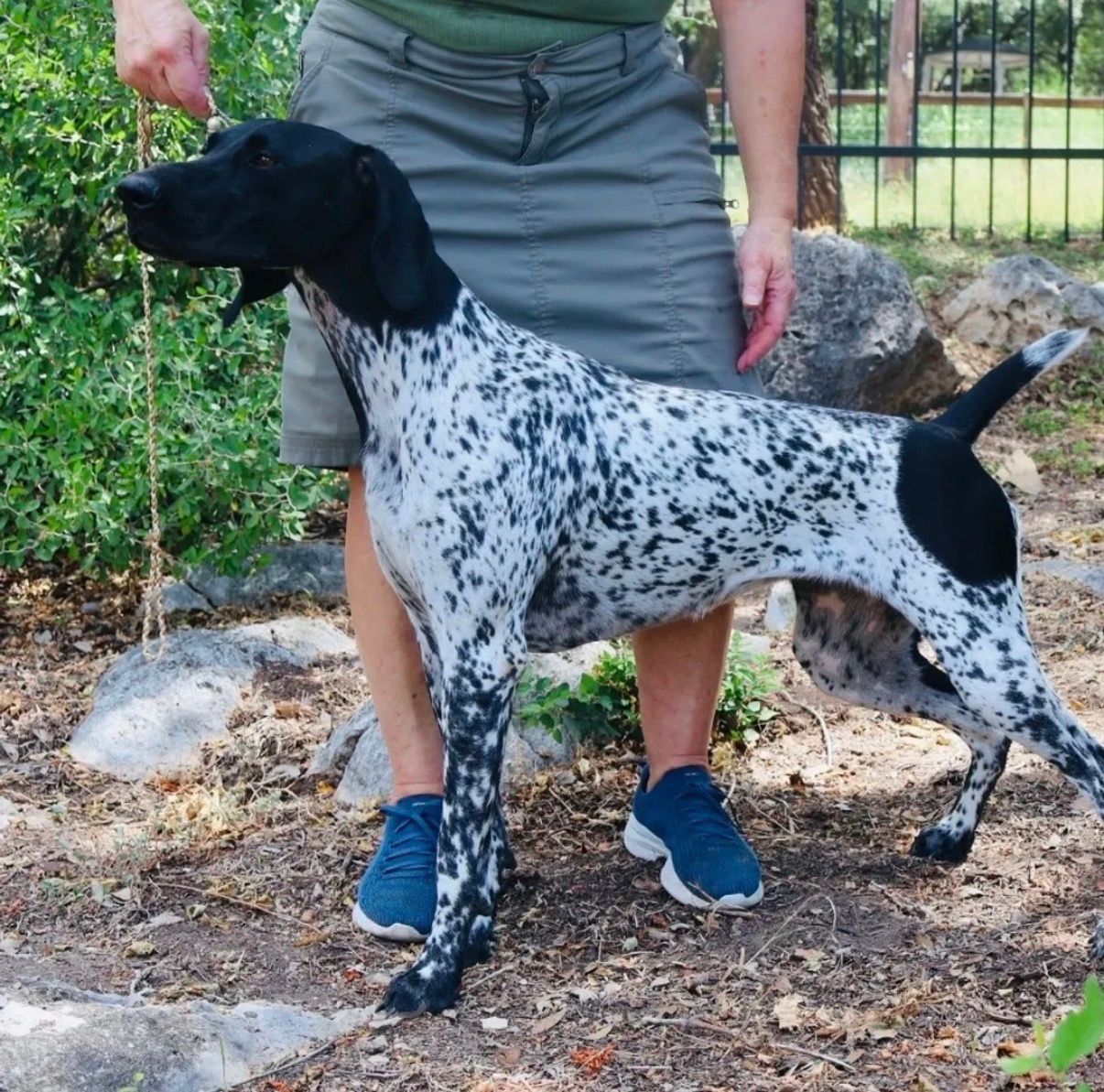
Or perhaps, if you've met a black roan like Valley:
"That's an interesting-looking Lab!"
Or maybe, after spotting all those beautiful patches and ticking:
"Is that a Dalmatian mix?"
They're some of the most common reactions black German Shorthaired Pointer owners hear—and they open the door to one of the most fascinating chapters in the breed's history.
Contrary to popular belief, black is not a modern color or a recent addition to the breed. In fact, black German Shorthaired Pointers have been part of the breed's European heritage for well over a century.
Where Did the Black Color Come From?
During the late 1800s and early 1900s, German breeders were carefully developing what would become today's German Shorthaired Pointer—a truly versatile hunting companion capable of pointing, tracking, retrieving on land and water, and serving as a devoted family companion.
As part of that effort, breeders introduced the black Arkwright Pointer into select breeding programs. Their goal wasn't simply to create a new coat color. They sought to strengthen pigmentation while preserving and refining the athleticism, instinct, intelligence, and versatility that define the breed today.
Within only a few generations, these dogs were fully accepted as German Shorthaired Pointers. Black wasn't considered a separate variety—it simply became another accepted color within the breed.
A Brief Timeline
1907 – The black Arkwright Pointer Beechgrove Bess is imported to Germany, helping introduce the black coat into the developing German Shorthaired Pointer.
1913 – Wach Tell, one of the earliest documented black-and-white German Shorthaired Pointers, is whelped.
1933 – Germany officially recognizes black and black-and-white as accepted colors within the breed.
1967 – Quell Pottmes is born and later becomes the first black-and-white Kurzhaar Sieger (one of the highest honors awarded within the German Deutsch Kurzhaar system), greatly influencing modern European black pedigrees.
2023 – The American breed standard is updated, allowing black and black-and-white German Shorthaired Pointers to compete in AKC conformation events.
Today – Valley, Odin, and their respective sires and dams proudly carry forward a historic coloration that has been part of the German Shorthaired Pointer's heritage for more than a century.
Why Didn't We See More Black GSPs in America?
When German Shorthaired Pointers became established in the United States, the earliest imports happened to be predominantly liver colored.
As the American breed standard developed, black was excluded from conformation competition, despite remaining an accepted color throughout Germany and much of Europe.
This often created confusion.
Black German Shorthaired Pointers could still be registered with the American Kennel Club, receive full pedigrees, and compete in nearly every performance venue—including Hunt Tests, Field Trials, Obedience, Rally, Agility, Fast CAT, Dock Diving, and more.
The only place they were excluded was the conformation ring because black was listed as a disqualifying color in the American breed standard.
That changed on January 1, 2023, when the breed standard was updated to welcome black and black-and-white German Shorthaired Pointers into AKC conformation competition.
The change didn't introduce a new color.
Instead, it brought the American breed standard into alignment with a color that had long been recognized as part of the breed's European heritage.
Color Doesn't Make the Dog
At Tipsy Rabbit, we believe coat color should never be the only reason a dog is chosen for breeding.
Health.
Temperament.
Structure.
Natural ability.
Trainability.
Heart.
Those qualities will always matter far more than whether a dog is liver or black.
Our decision to welcome Odin into our breeding program wasn't based on color alone. We chose him because of the complete package he represents—his pedigree, structure, temperament, instinct, and the promise he already shows as a young dog.

Likewise, Jett Jr. and Valley's addition to our program reflected the same thoughtful approach. Together, they represent generations of purposeful breeding and a shared commitment to preserving the qualities that define the German Shorthaired Pointer.
Their historic German black roan and black-and-white coats simply add another beautiful chapter to the story of this remarkable breed.
Preserving the Breed We Love
One of the things we appreciate most about the German Shorthaired Pointer is its versatility.
Whether liver or black, every well-bred GSP should embody the same characteristics that have made the breed beloved for generations: intelligence, athleticism, sound structure, natural hunting ability, and an affectionate, eager-to-please temperament.
While black-and-white may catch your eye, it has always been more than a color. It represents a living piece of the German Shorthaired Pointer's rich history—one that continues to be preserved by dedicated breeders around the world and celebrated by families who cherish this incredible breed.
Built for the field. Raised for the family.
📸 Featured TopDogs and TopPups: Lady Raben-Valentinstag, call name Valley, Alvardo Farm's Venus Moon and TTR's new addition Odin Ascending Under Venus Moon.